The built-in error occurs when you’re cutting a square diagonally to make triangles.
And he explains how he designed some "extension bars" to solve the problem - ;))
I'm a math geek - so I thought it was a VERY interesting article -
And he makes some good points -
But I noticed a few things as I was reading along -
And I have a totally DIFFERENT solution to the problem - ;))
If your quilt pattern includes a quilt block with triangles, it also includes a built-in error. And it’s all because of your rotary cutter.
Hmmm - Not necessarily - the built-in error part - because of your rotary cutter.
I think it has more to do with the method used than the rotary cutter itself - ;))
You probably thought that if your triangles didn’t match perfectly with your squares, there must be something else going on—maybe you didn’t cut as accurately as you thought, or the problem was sewing them together on the bias.
Then he goes on to say -
As you may probably know, we are told to add 7/8″ to a square that will be cut in half for Half-Square Triangles, and 1¼” to a square that will be cut in quarters for Quarter-Square Triangles.
I agree that we are told to add 7/8" and 1-1/4" -
BUT -
Who says we all cut a square and then cut it in half for a HST? -
What if you cut a strip and want to cut a HST from that? -
Before rotary cutters, quilters just made templates (some of you may remember cutting shapes from empty cereal boxes). The only seam allowance measurement a quilter ever needed to know was a quarter inch. Making templates and cutting with scissors was tedious, but there was no complicated seam allowance math. You simply drew your triangle, and add(ed) a quarter inch all around.
Haha - that's EXACTLY what I did when I designed the LEFT-EZE™ Rule -
I drew a triangle and added a quarter inch all around - ;))
It was much faster to use a rotary cutter and ruler to cut squares and then cut them diagonally into Half- or Quarter-Square Triangles. But if you did that, you would obviously need to add more than the standard half-inch, because you needed the extra quarter inch on the diagonal edges as well.
Is it really faster to cut squares and then cut them diagonally into HST and QST? -
I know I do that when I'm cutting Side Triangles and Corners - but that's because they are so big - and I usually cut them oversized and trim them down later -
Sometimes I just have a bunch of strips that I want to use - and I want to cut HST and QST from them -
But I agree with the "you needed the extra quarter inch on the diagonal edges as well." -
The built-in error occurs when you’re cutting a square diagonally to make triangles.
So - don't cut squares diagonally to make triangles - problem solved - LOL - ;))
And - last but not least -
finished-size math.
I know pattern designers use "finished" size math - but I don't really care what the "finished" size is to start with. If I have some strips or "units" already sewn - all I want/need to know is what size cut square I can match to it - and if I subtract 1/2" for the seam allowances - that tells me the "finished" size -
What I really want to know is the "unfinished" unit size - OR -
Which bag of pre-cut strips do I pull for this project? - LOL - ;))
The built-in error occurs when you’re cutting a square diagonally to make triangles.
So - yes - there is fuzzy math if you cut a square first and then cut HST and QST -
Because of the rounding of the additional 7/8" and 1-1/4" -
BUT -
I said that I have a totally DIFFERENT solution to the problem - ;))
First - I don't cut a square diagonally to make triangles - I cut them from strips -
Second - I use a triangle ruler/template with the seam allowances built in -
And Third - I forget about the "finished" size - ;))
If you're trying to follow a pattern that gives "finished" size -
You can use the FREE SIZE CHART to figure out what size strip you need -
It even has columns for patterns that say to cut a square -
LEFT-EZE™ RULE - SIZE CHART - NO MATH REQUIRED
Easily find the STRIP WIDTH needed to make the size you want -;))
***NOTE - IF THE PATTERN SAYS TO CUT A SQUARE -
USE THIS COLUMN TO FIND THE STRIP SIZE YOU NEED
Or you can make something from the strips that you have already cut - ;))
In the olden days -
No fuzzy math -
You simply drew your triangle, and added a quarter inch all around.
Yep - that's what I did when I designed the LEFT-EZE™ Rule -
I did it the "old-fashioned" way - and it works quite well - ;))
I take two strips - right sides together - line up the ruler -
With the black tip on the top -
You can SEE the 1/4" seam allowance on the diagonal -
The same 1/4" is "built-in" on the side and bottom -
So you don't need to worry about it -
Make the second cut -
You can see the SAME 1/4" seam allowance on the diagonal -
And - sometimes - for some reason - my second cuts are a "smidge" too big -
So when that happens - I trim it now -
It saves me from having to trim the HST after it is sewn -
Sew it from the flat top side - 1/4" seam allowance -
The flat top is the dog-ear that is automatically cut off because I used a strip -
Block #28 - Rocky Road to California - Except that it isn't - LOL - ;))
I didn't notice until I linked to the other block -
That I have all of the 4-patches going the "wrong" way - oops -
Does that make it an original block - or a twisted variation? - ;))
And I'm building this quilt top "backwards" - just so you know - ;))
I cut and assemble all of the Border units and Sashing first - because - to me - this is the "chore" part - and after I finish my "chores" - I can PLAY with the Sampler Blocks -
When all of the Sampler Blocks are made - I can assemble the quilt top -
The assembly will be done in SECTIONS - not rows -
The oversized Side Triangles make the LEFT Side a bit funky to sew - ;))
Also - I'm 99.999% sure that my piece count MATH is correct - BUT - if it isn't - PLEASE let me know!! I'm pretty good - but I'm not perfect - LOL - ;))
===
Smaller Version - 50" square -
16 Side Triangles - QST - 4 sq @ 14" x 14" - cut diagonally twice
4 Corner Triangles - HST - 2 sq @ 8-1/2" x 8-1/2" - 10" x 10" - cut diagonally once
16 Border Blocks - 3 strips @ 6-1/2" x WOF - subcut squares 6-1/2" x 6-1/2"
Larger Version - 60" square -
20 Side Triangles - QST - 5 sq @ 14" x 14" - cut diagonally twice
4 Corner Triangles - HST - 2 sq @ 8-1/2" x 8-1/2"- 10" x 10" - cut diagonally once
36 Border Blocks - 6 strips @ 6-1/2" x WOF - subcut squares 6-1/2" x 6-1/2"
===
Both versions have 25 sampler blocks - but the Larger Version has one more round of Border Blocks and the corresponding/additional Side Triangles.
I prefer to cut the larger pieces first so I cut the Side Triangles - Corner Triangles - and Border Blocks first. Save the scraps for cutting the Cornerstone Strips. Any excess yardage can be used for additional Cornerstone Strips - if needed - and/or the Binding.
The Sashing Strips are cut from a second fabric/color.
Since I made the Larger Version - 60" x 60" - these instructions will show the photos of my process - and the instructions/piece count for the Larger Version. The numbers needed for the Smaller Version will be shown in parentheses.
===
Side Triangles - 20 (16) QST -
Summary -
Cut 3 (2) strips @ 14" x WOF - trim the selvages (assumed on ALL strips)
Sub-cut 2 Squares @ 14" x 14" - oversized by design - from each of two strips -
Subcut the 4 squares on the diagonal - in both directions - Yield 16 QST -
Sub-cut 1 (0) Square @ 14" x 14" - oversized by design - from third strip -
Subcut the square on the diagonal - in both directions - Yield 4 QST -
NOTE - You may cut your squares smaller to conserve fabric (and possibly get more per strip) but you will skimp on the oversized outer edges - your choice - ;)) EDIT UPDATE - I would not cut them smaller than 13". The setting triangles may seem VERY large - but - not if you consider that the finished size of the "sashed" block is 8". Most charts say 12-5/8" and I rounded that up to 13" - then added an inch for my "oversized" built-in border - ;))
There is method in my madness - LOL - ;))
Detail -
First strip - folded fabric - 14" squares - 2 layers - for 8 QST -
Do the same for the second set of 14" squares - 2 layers - for another 8 QST - Save any scraps for Cornerstone Strips - to be cut in Part 2 -
Cut diagonally - in both directions for QST -
LEFT-HANDED - first cut from bottom left to top right - diagonally for QST -
Cut a second time on the other diagonal - bottom right to top left -
Smaller Version - you have your 16 QST for the Side Triangles -
Larger Version - you need 4 more QST -
Unfold the third/last strip - trim the selvage -
And cut a 14" square off the end - for last set of QST -
QST - 4 more for 20 total -
Save the remainder of the strip for the Corner Triangles -
To be cut next -
===
Corner Triangles - 4 HST -
Summary -
Cut 2 Squares @ 8-1/2" x 8-1/2" - 10" x 10" - oversized by design -
Subcut each square on the diagonal - once - to yield 4 HST -
Detail -
If you're making the Smaller Version - cut a strip 8-1/2" 10" x WOF -
If you're making the Larger Version -
Cut a 8-1/2" 10" strip off the 14" piece that was left over from the last 4 - QST above -
For BOTH Versions - cut 2 sq at 8-1/2" 10" for Corner HST -
HST - cut once diagonally
Corner HST - 4 -
Corners - HST - Put a pin in them to distinguish them from the QST -
Save any scraps for Cornerstone Strips - to be cut in Part 2 -
===
Border Blocks - 36 (16) Squares -
Cut 6 (3) strips @ 6-1/2" x WOF -
Sub-cut each strip into squares @ 6-1/2" x 6-1/2"
===
Next up -
Cutting the Sashing Strips and Cornerstone Strips -
And then decided to write up ONE set of instructions for ONE size -
The 60" square version -
LHQSQ2-Version B
59.4" square - rounded up to 60"
6x6 on-point layout - 4x4 blocks with two rounds of border blocks
25 Sampler Blocks - 6" finished
36 Border Blocks - 6" finished
Yardage for the Gray areas - 3-1/4 - 3-1/2 yd
Yardage for the Beige/Sashes - 1-1/4 - 1-1/2 yd
If you want to make a smaller size - you can omit the outer row of border blocks -
If you want to make a larger size - you can add rows and/or columns and adjust accordingly - ;))
For this one -
I got some of the pieces cut -
And will give you all the details later when I write up the pattern/instructions -
I started with this beautiful Cornflower Blue that I had in my stash -
For the Border Blocks - Side Triangles - and Corners -
Then found this Light Gray -
For the Sashing - Cornerstones -
The Sampler Blocks will need a variety of light/medium/dark -
In two or three color families -
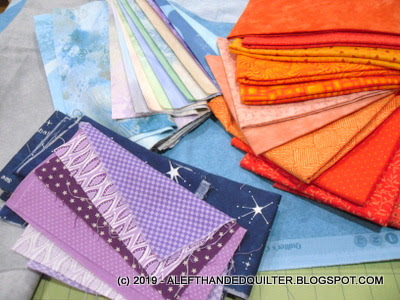
So I added a Scrap Bag pack of 12 - 1/4 yd cuts -
The values range from light to medium -
Some blues and grays - with a couple of greens - yellows - lavenders - mixed in -
But that looked a little boring -
So I added some ORANGE - light/medium/dark -
And then some scraps of PURPLE - light/medium/dark - just because - ;))
And some NAVY BLUE - because I want/need some more darks in the mix -
Then I realized that I had an ORANGE jelly roll -.
With some light/medium/dark -
So I substituted that for my yardage -
And then I found a GRAY jelly roll - light/medium/dark -
And one with a variety of NEUTRALS -
Almost forgot about the NEUTRALS -
Added them to my box - and now I have this -
And that should get me started - LOL - ;))
This is WAAAAY more fabric than I need - but I want to use my LEFT-EZE™ Rule and 2-1/2" strips for most of the "units" - and the jelly rolls are already cut - LOL.
I may find scraps that I want to use, too - and I reserve the right to make changes as I go along - so anything is fair game - ;))
First I'll play with the Border Blocks - Side Triangles - and Corners -
Get them cut - and up on the wall -
Then play with the Sashing - Cornerstones -
I'll post the piece count - cutting sizes - and other details later -
So - while I play with that -
You can be thinking about the colors you want to use in your Sampler Quilt - ;))